
A Nature Medicine Paper Linking Picloram To Early-Onset Colorectal Cancer Leaves An Open Question
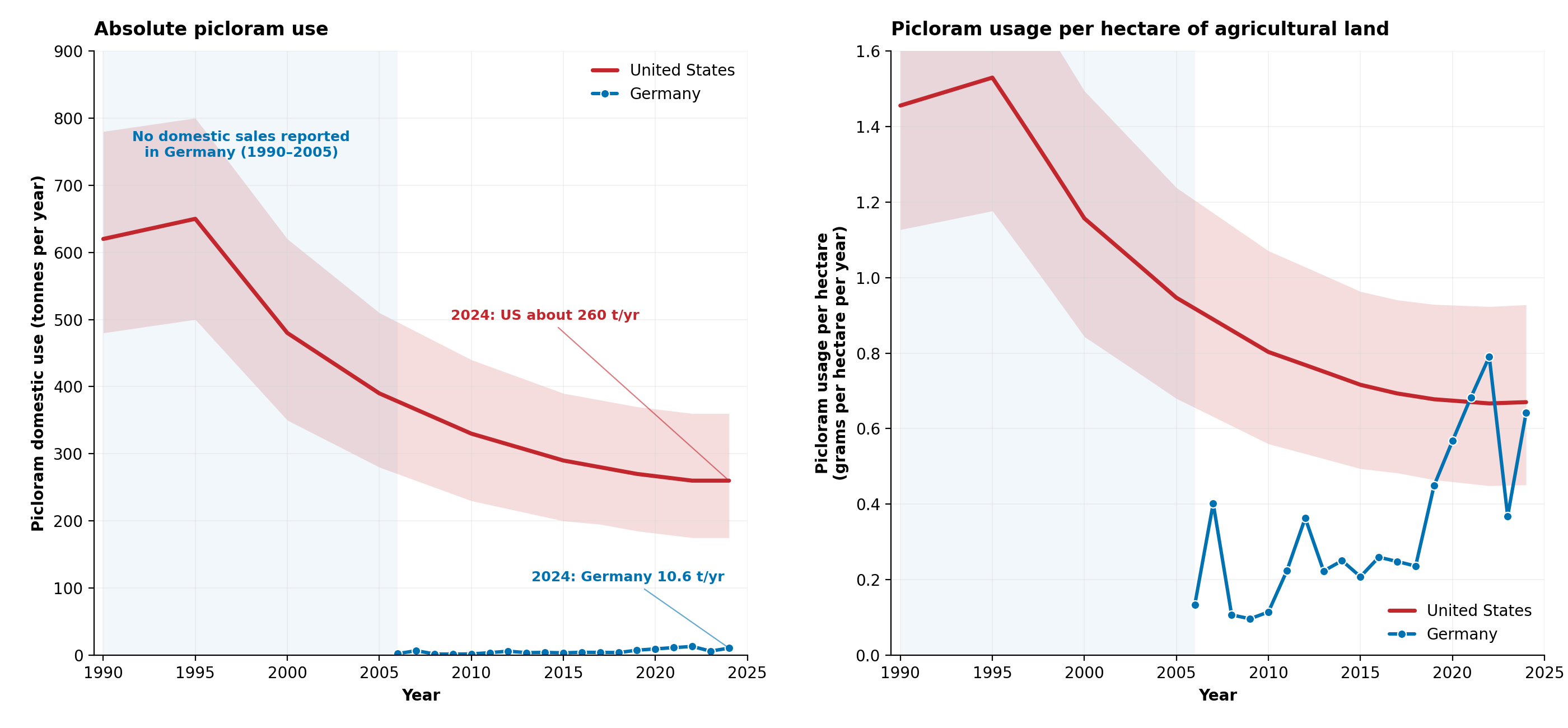
Maas et al. link picloram to early-onset colorectal cancer in the United States. Yet the incidence of early-onset colorectal cancer rose in parallel in Germany, where publicly available national herbicide sales data report zero picloram sales for 16 consecutive years (1990–2005).


A recent Nature Medicine paper by Maas et al., covered on the All-In Podcast, links the herbicide picloram to early-onset colorectal cancer (EOCRC). The authors derive a DNA methylation signature for picloram exposure and find it more common in EOCRC than in late-onset disease, both in a TCGA discovery cohort and in a meta-analysis of nine further cohorts. The authors then examine 94 US counties from 1992 to 2012 and find that higher picloram use is associated with higher EOCRC incidence after adjustment for socioeconomic factors and 26 other pesticides. Their discussion proposes a lifetime-exposure mechanism: today's EOCRC patients grew up after picloram entered the farm and food environment.
EOCRC in young adults is often diagnosed late, which worsens prognosis substantially, so linking a herbicide to it is a serious claim that deserves a careful look. The authors use the USGS Pesticide National Synthesis Project, which estimates pesticide application on cultivated cropland and pasture but does not cover rangeland, forestry, rights-of-way, or roadsides. According to EPA usage data, those uncovered categories account for a substantial portion of US picloram application by both volume and acres treated.
Picloram itself is a synthetic auxin herbicide, first registered in the US in 1964 and classified by the EPA as a Restricted Use Pesticide since 1978. Its dominant uses are rangeland, pasture, forestry sites, and rights-of-way rather than row crops.
Germany is one of the few countries with both publicly available picloram use data and a directly comparable EOCRC time series. National pesticide sales are reported every year by the BVL under §64 of the Pflanzenschutzgesetz. The picloram series shows three small entries (0.4 to 0.6 tonnes per year) in 1987 to 1989, then sixteen consecutive years of no domestic sales from 1990 through 2005, then a return to the market in 2006 at 2.3 tonnes, climbing to 13.0 tonnes in 2022, 6.1 in 2023, and 10.6 in 2024.
Dharwadkar et al. (2022) report that EOCRC incidence in the United States rose from 8.6 to 12.9 per 100,000 between 1992 and 2018 in SEER 13, an annual increase of about 1.6%. In Germany, Tanaka et al. (2023) reported annual increases of 1.16% in men and 1.32% in women over 1999–2018, using ZfKD registry data from the federal states of Bremen, Hamburg, Rhineland-Palatinate, Saarland and Schleswig-Holstein plus the Münster region, covering about 16% of the German population. The trends are similar in magnitude, although the observation windows are only partially overlapping (US 1992–2018 vs. Germany 1999–2018).
This raises a question about the proposed lifetime-exposure mechanism. Germans now in their thirties and forties largely grew up while picloram was effectively absent from the domestic market, yet EOCRC incidence rose there at almost the same pace as in the US. The only residual route is dietary residues, but EU monitoring data suggest this contribution is small: in EFSA's 2024 review, picloram fell below the limit of quantification (typically 0.01 mg/kg) in all 2,386 EU samples of animal fat and liver collected from 2013 to 2023, and in all 185 honey samples.
That said, two trends rising in parallel are not, on their own, evidence of a shared cause. EOCRC incidence has been rising across many Western countries, and the similar slopes in Germany and the US could reflect different drivers in each population. Whether picloram contributes to EOCRC and why EOCRC is rising at all are separate questions.
A few follow-up steps would help. Applying the picloram methylation signature to EOCRC tumors from German patients would test the exposure hypothesis directly, by comparing signature prevalence against US tumors. Direct measurements of picloram in groundwater and food residues in both countries would also be valuable, since BVL sales and USGS application estimates are only indirect proxies for what people actually ingest. Without this kind of data, it is hard to tell whether picloram is a major driver of EOCRC, a minor contributor among many environmental factors, or a marker for something else that travels alongside it.
Follow me on X for frequent updates (@chaotropy).
Disclaimer: The US picloram values shown in the figure are reconstructed from a small number of historical anchor estimates plus a partial USGS time series, and the year-to-year shape between anchors is interpolation, not measurement. The German BVL table reports domestic sales, which is not the same as total exposure (food residues, imported products, and any non-reported use are not captured). The Tanaka cohort covers five of sixteen German federal states plus the Münster region. The Maas et al. discovery cohort is small. None of this is a definitive evaluation of the Maas paper. This article is not medical advice.
Copyright: All original content, including text, simulation code, and figures, is the property of the author and may not be copied, reproduced, or published, in whole or in part, without prior written consent, except as permitted by applicable law or the terms of the platform on which it is published. Use of this content for training machine learning or AI models is not permitted without explicit authorization. Third-party or public domain images remain subject to their respective rights and are not claimed as the author's property.