A Blue-Sky Estimate For Daraxonrasib (Rasonque) US Sales In Pancreatic Cancer
A patient flow simulation of US net sales of daraxonrasib (Rasonque) in pancreatic cancer in a blue-sky scenario results in $14.5 billion in 2035 (range $11.6 to $18 billion), assuming that all ongoing trials and a hypothetical neoadjuvant program succeed and ignoring competing drugs.

Disclosure: The author holds beneficial long positions in Revolution Medicines, Inc. (NASDAQ: RVMD) and Verastem, Inc. (NASDAQ: VSTM). The author holds no long or short position in any other company mentioned. This article is for informational and educational purposes only and is not financial advice. Although the author is a physician, this content is commentary on the underlying science and does not constitute medical advice, diagnosis, or treatment recommendation. The author receives no compensation for this article and has no business relationship with any company mentioned. Biotech investing is extremely risky and can quickly lead to a total loss of principal. See the full Legal Information and Disclosures section below.
Important Notice: The following model and its results are a blue-sky scenario and assume that all ongoing registrational trials and one hypothetical neoadjuvant program of daraxonrasib in pancreatic cancer succeed, that daraxonrasib gets approval in all targeted indications and that it is widely adopted, while potentially competing drug candidates are ignored. The purpose of this theoretical modeling exercise is to explore the potential market of a targeted drug in pancreatic cancer. This is not a realistic forecast of drug sales. This is not financial advice.
In April, Revolution Medicines (RevMed) reported the results of the phase 3 RASolute 302 trial in second line (2L) metastatic pancreatic ductal adenocarcinoma (mPDAC). Median overall survival (OS) was 13.2 months with daraxonrasib vs. 6.7 months with standard of care (SOC) chemotherapy (HR: 0.40).
This readout marked an inflection point for a disease that still had no targeted therapy (apart from small subgroups such as the patients with a BRCA mutation who benefit from olaparib). Videos showing the standing ovation of nearly a minute at the ASCO plenary session went viral in late May. Seven months after the initial phase 3 readout, Revolution Medicines reported $197.6 million in net product revenue for Rasonque (daraxonrasib) from about five weeks on the market after the FDA approval on August 26. According to RevMed, more than 5,000 US patients received the commercial drug in that period.
RevMed attributed part of that revenue to expanded access patients, to patients who had been waiting for approval and to initial channel stocking. Management even cautioned against reading the quarter as a guide to the longer-term trajectory. One should always take caution from the company itself seriously, but I cannot help being very optimistic about the commercial potential of Rasonque.
But before I start, you, the reader, have to know that I am definitely biased. Not only because I am long the stock, but also because my whole professional environment has waited decades for this therapy.
I started doing research on PDAC in 2017 in med school. Six years earlier Conroy et al. had shown that the three-agent conventional chemotherapy regimen FOLFIRINOX substantially improves survival in mPDAC. This landmark trial revitalized research in PDAC, which had been in agony for years, by showing that improving survival in metastatic disease is possible.
While targeted therapies were already long established for other solid tumors like HR+ breast cancer, the only approach that seemed to work in PDAC was combining more toxic conventional drugs into regimens that bring patients to the brink of what is tolerable (while drugs to treat side effects had improved). At the same time, it was well known for decades that PDAC is mainly driven by KRAS, but the KRAS mutations most relevant in PDAC were still thought to be undruggable.
Nomen est omen, Revolution Medicines broke this paradigm and almost ten years later I am sitting here and reasoning about potential sales of an orally available Pan-RAS inhibitor that showed an unprecedented substantial survival benefit in 2L mPDAC. This still gives me chills. So yes, I am as biased as one can be. Patients, healthcare providers and researchers have wished for a drug like daraxonrasib for a very long time.
At the same time, I am clearly no expert in forecasting drug sales. So whoever reads this, I urge you to read it just as a modeling exercise. When I write in my disclaimers that "this is not financial advice", this is not just a phrase. Since I do not know much about lung cancer, this article focuses only on the potential sales of daraxonrasib in PDAC and ignores other drug candidates and other potential indications.
In what follows I will lay out my assumptions for a patient flow model to estimate US sales, and US sales only. I will not look into international sales or potential effects of international pricing on US revenue.
Although daraxonrasib is a breakthrough, mPDAC still has a poor prognosis, meaning that patients in 2L (the currently approved indication) will not take this therapy for a median of years but of months. Each patient who starts treatment receives a 30-day supply every 30 days until treatment stops. The model assumes that the risk of stopping treatment is the same in every month, so some patients stay on treatment much longer than the median. Without a time limit, the average time on treatment is about 1.4 times the median. Net sales are paid supplies times the net price.
Since I cannot estimate any parameter with precision, every parameter was swept across a range, with 50,000 runs of the model in which each of these parameters was drawn at random. So the ranges plotted below contain the middle 90% of these runs. Even their low ends belong to an optimistic blue-sky scenario, since the model ignores competing drugs and shows potential sales beyond 2L mPDAC for the case that every ongoing, planned or even not announced registrational trial of daraxonrasib in PDAC succeeds. So my assumptions might very well be wrong and render my estimates obsolete.
In each of the 50,000 runs, the model follows the patients from one line of therapy to the next. A value drawn for one line can therefore change the sales in another. If, for example, the ongoing phase 3 trial RASolute 303 in previously untreated patients with mPDAC shows a large benefit in progression-free survival, a very large share of first-line patients may start with daraxonrasib as monotherapy or in a combination instead of chemotherapy alone. Fewer patients are then left to start it in 2L, so the 2L sales shrink in the runs that draw such a result.
Rasonque has a list price of $39,800 for a 30-day supply, but list prices are usually not paid in reality. The company's quarterly report deducts government rebates, chargebacks for 340B entities and veterans' hospitals, cash discounts, returns and co-pay assistance. On the earnings call, management put the total gross-to-net discount at the low end of a 20% to 30% range for the launch quarter and expects it to rise. The discount after the launch quarter was swept across that range, which leaves $27,860 to $31,840 per supply.
Medicare drug plans must cover nearly all cancer drugs. RevMed reports reimbursed claims from plans with more than 90% of covered lives. Uninsured or underinsured patients can get the drug for free from the company. RevMed has not disclosed how many supplies are free. In a US cancer registry, 4% of patients with metastatic pancreatic cancer were uninsured and 55% were on Medicare, where about 11% of beneficiaries lack sufficient drug coverage (together about 10% of all patients). The model rounds both values to the nearest 5% and counts 90% to 95% of the supplies as paid.
Patients in the RASolute 302 phase 3 trial underwent imaging every eight weeks and stayed on treatment until progression, toxicity or withdrawal, with progression as the reason for three of four discontinuations. Median progression-free survival (PFS) by central review was 7.2 months with daraxonrasib and 3.6 months with SOC chemotherapy. The reported median treatment duration of 6.2 months was recorded when 42% of patients were still on treatment, so it may understate how long patients stay on the drug. Assuming the same risk of progression in every month, a median PFS of 7.2 months leaves 56% of patients free of progression at six months, which matches the 56% reported in the trial.
Scans in routine care are usually less frequent than in the trial (the ASCO guideline recommends a first scan two to three months after the start of therapy and clinical assessment in place of routine imaging after that), so progression outside a trial setting may be detected later on average. Some oncologists may also continue an oral drug through slow progression when conventional chemotherapy is the only alternative. Frailer patients than those who enrolled in the trial would probably stop treatment earlier.
The median time on treatment with daraxonrasib in 2L mPDAC was therefore swept from 5 to 8 months. Both ends are my own assumptions, as I found no data on the time on treatment in routine care yet. The low end lies about a month below the reported median treatment duration of 6.2 months and stands for the frailer patients of routine care. The high end adds about two weeks for scans every twelve instead of eight weeks and about two weeks of treatment beyond progression to the trial's PFS of 7.2 months, which gives about 8 months. Refills were swept from 84.7% to 93.1% of the schedule, the mean and the median dose intensity in RASolute 302, in which 69% of patients interrupted treatment for adverse reactions.
The American Cancer Society expects 67,530 new pancreatic cancer diagnoses and 52,740 deaths in the US in 2026. About 90% of the diagnoses are PDAC. PDAC has a far poorer prognosis than neuroendocrine tumors (five-year survival of 8% vs. 72%), so about 95% of the deaths (about 50,000) are probably from PDAC. In an autopsy series, 88% of PDAC patients had metastases, which leaves about 44,000 deaths that followed metastatic disease. The company's presentation counts about 55,000 patients per year whose PDAC is metastatic at diagnosis or at relapse. This number was therefore swept from 44,000 to 55,000.
About 74% of patients with mPDAC receive first-line (1L) therapy today and 46% of those reach 2L. However, both figures date from the era in which 1L and 2L were intravenous conventional chemotherapy. So I would assume that the share of patients who start 2L will most likely rise if it is the first targeted oral drug available.
Additionally, I would assume that some patients who are not in the condition to start a 1L conventional chemotherapy might still be able to start daraxonrasib. Importantly, the label covers this case, since the FDA approved Rasonque for adults with metastatic pancreatic adenocarcinoma who have received at least one prior systemic therapy and for those who are not candidates for multiagent systemic therapy.
Many patients who decline or do not tolerate more conventional chemotherapy, which is administered as an intravenous infusion at an oncologist's practice or in a hospital, will probably want to take an oral drug instead. In RASolute 302, only 1.2% of patients stopped daraxonrasib because of treatment-related adverse events.
The share of 1L patients who go on to daraxonrasib was therefore swept from 45% to 80%. The low end is about today's share of 46% who reach 2L. The high end assumes that every patient who is still alive at the first scan goes on to daraxonrasib. This scan is due three months after the start of 1L therapy at the latest. In Medicare claims of patients with metastatic pancreatic cancer from 2013 to 2017, the 90-day survival rate with 1L treatment was 79%, which the model rounds to 80%.
In a 2022 study of the Flatiron Health database, which collects the records of US oncology practices, only 56% of 1L patients stopped 1L chemotherapy and were still alive 30 days later. At that time, the next line was a second conventional chemotherapy. With daraxonrasib as the next line, patients probably have an incentive to switch earlier, at the first progression or as soon as chemotherapy is no longer tolerated. Every share above 56%, including the central case of the model, assumes such an earlier switch.
The company's figure of 74% of metastatic patients who receive 1L therapy matches the Flatiron Health database, in which 5,687 of 7,666 patients with mPDAC received at least one line of systemic therapy between 2014 and 2019. A more recent analysis of ConcertAI data, whose authors include employees of Revolution Medicines, covers 2,708 US patients whose PDAC was metastatic at diagnosis between 2020 and 2025 and combines the records of oncology practices with insurance claims. In this analysis, 65% of the patients received systemic therapy. The share of metastatic patients who receive 1L therapy today was therefore swept from 65% to 74%.
The remaining 26% to 35% of metastatic patients receive no systemic therapy today. In a Danish cohort of 91 untreated patients with pancreatic cancer, about half of them with metastatic disease, 11% had declined treatment without an objective reason, poor performance status was a reason in 70% and the median survival was 2 months. Of the 953 untreated patients in the ConcertAI analysis, 39% had a good performance status.
The model rounds the 11% and the 39% to 10% and 40% and takes them as the low and the high end of the share of untreated patients who start daraxonrasib as their first treatment. Their median time on treatment was swept from 2 months, the median survival without treatment in the Danish cohort, to 6.2 months, the median treatment duration reported in RASolute 302. Counting in these patients, 69% to 84% of metastatic patients receive a 1L treatment in the model. Without daraxonrasib, 65% to 74% do, as described above.
FOLFIRINOX has no specific FDA approval in pancreatic cancer and is still one of the most common regimens, so off-label prescribing is routine in PDAC. For Rasonque, the NCCN guideline already lists 1L use in metastatic disease as "Useful in Certain Circumstances", depending on the prescriber's assessment of performance status. The label covers adults "who are not candidates for multiagent systemic therapy". This wording may therefore be applied to more patients than the model assumes. I found no data on how often this happens, so the model ignores this. Before a 1L label, the model assumes daraxonrasib as a first treatment is only given to patients who receive no systemic therapy today, which might underestimate uptake as 1L treatment.
According to RevMed, more than 5,000 US patients received commercial daraxonrasib in the five weeks after approval. In the model, only 700 to 2,200 patients come off 1L therapy or start daraxonrasib as their first treatment in these five weeks. The other 2,800 to 4,300 patients were probably waiting already, in the expanded access program or for the approval. The model treats them as a launch cohort, a group that starts treatment once at launch and is not replenished.
Management described many of these early patients as later-stage with a lower performance status. The median time on treatment of the launch cohort was therefore swept from 2 to 6 months instead of 5 to 8 months. New patients do not all start daraxonrasib from the first day, since a new drug is not adopted everywhere at once. On the day of approval, the model lets only 20% to 80% of the new patients described above start it. This share rises steadily and reaches 100% after 3 to 12 months. These three ranges are my own assumptions.
A 1L label is pivotal for the company. In the central case of the model, 1L mPDAC accounts for about 70% of the sales in 2035. Whether RASolute 303 succeeds and daraxonrasib gets approved as 1L treatment in mPDAC cannot be known yet. RASolute 303 tests daraxonrasib as monotherapy and in combination with gemcitabine + nab-paclitaxel (GnP) against SOC chemotherapy alone in about 900 previously untreated patients. The company expects to complete enrollment in the first half of 2027. In uncontrolled phase 1/2 cohorts of about 40 patients each, 71% of patients on monotherapy and 84% on the combination were free of progression at six months. At the ENA symposium in November, the company presented an update of the combination cohort with 61 patients and a median follow-up of 18.3 months. The cohort reached a confirmed response rate of 60.7%, a median PFS of 12.8 months and a 12-month OS of 76.6%. I may already bore you with my excitement but these early results in 1L mPDAC are fantastic.
If the 1L phase 3 trial succeeds, the model assumes a 1L label between July 2028 and November 2029. On its third-quarter earnings call, the company gave no date for the readout or for an approval in 1L. So the early date estimate follows from the pace of RASolute 302. Its registry entry estimated the primary completion for June 2026, but the data cutoff came about four months earlier and the FDA approved daraxonrasib in August 2026. The registry entry of RASolute 303 now estimates the primary completion for April 2028, so the same pace leads to a label at the end of June 2028. The late date allows 16 more months in case the trial needs longer to collect its events or the approval has to wait for mature data on OS.
With a 1L label, patients could start potentially with daraxonrasib monotherapy or daraxonrasib + GnP instead of chemotherapy alone. The model assumes that 65% to 90% of today's 1L patients would do so. The high end leaves out the 6% who receive experimental drugs in clinical studies today, because they would probably enter a study again. The low end also leaves out the 27% who start on FOLFIRINOX today. RASolute 303 compares daraxonrasib with GnP and not with FOLFIRINOX or NALIRIFOX, so oncologists may keep FOLFIRINOX or NALIRIFOX as the first treatment for their fittest patients and give daraxonrasib after it. Both ends are rounded down to the next 5% (from 67% and 94%), because a few other patients will probably not start with daraxonrasib either. Patients who start daraxonrasib in 1L are not counted again in later lines.
Daraxonrasib will only be approved in 1L if it is superior to GnP, the comparator of RASolute 303. Two arms of about 300 patients can show a difference as significant at the usual 5% level only if the HR is below about 0.80, once half of the patients have progressed or died. The median PFS that daraxonrasib needs for this depends on how the comparator arm performs. GnP reached a median PFS of 5.6 months in NAPOLI-3 and of 7.1 months in the control arm of HALO 109-301, the longest among the phase 3 trials I found. Against 7.1 months, an HR of 0.80 would mean a median PFS of roughly 9 months.
The median PFS on 1L treatment, which the model takes as the median time on treatment, was therefore swept from 9 to 12.8 months. With a shorter PFS, the trial could fail against a strong comparator arm, so such values are left out. The 12.8 months of the phase 1/2 cohort also make a shorter PFS less likely. The high end is the median PFS of the uncontrolled combination cohort described above, since the primary endpoints of RASolute 303 compare this combination with chemotherapy.
The better the result of RASolute 303, the more patients would probably start with daraxonrasib. At a median PFS of 9 months, oncologists may still keep FOLFIRINOX or NALIRIFOX as the first treatment for their fittest patients. At a PFS of 12.8 months, few of them would probably do so. In every run of the model, the share of 1L patients who start with daraxonrasib therefore depends on the PFS. It is 65% at a PFS of 9 months and 90% at 12.8 months. Between these two values, the share rises evenly with the PFS. After each new label, uptake rises to the assumed share within the same 3 to 12 months as after the launch.
RASolute 302 and 303 test daraxonrasib in mPDAC. RASolute 304 tests it in patients with resectable, meaning locally confined, disease in the adjuvant setting. These patients could potentially be cured of pancreatic cancer by surgery in combination with drug therapy (surgery with adjuvant systemic therapy can cure patients today, who are among the 8% of patients with malignant tumors of the exocrine pancreas surviving longer than five years). But this is hypothetical, as we do not know if daraxonrasib adds a benefit after conventional chemotherapy in this setting. Since I want to explore potential sales, I will assume that this works (which we do not know!).
RASolute 304 randomized its first patient in December 2025. It compares daraxonrasib with observation in about 500 patients after resection and perioperative chemotherapy, with disease-free survival (DFS) as the primary endpoint. Treatment lasts two years in the company's presentation. The trial's registry entry allows up to about five years for the primary endpoint.
If RASolute 304 succeeds, the model assumes a label between August 2029 and August 2032. The early date follows from the pace of RASolute 302 again. The trial's entry on ClinicalTrials.gov estimates the primary completion for May 2029, so the same pace as in RASolute 302 leads to a label in July 2029. The three years after the early date leave room for a late readout, because the primary analysis of such a trial usually waits for a set number of recurrences or deaths and these come later the better daraxonrasib works. On the last earnings call, the company gave no date for the readout of this trial either.
If adjuvant daraxonrasib improves survival after surgery like it did in 2L metastatic disease, I see no reason why patients who underwent surgery should get something else as long as no other targeted therapy is approved in this indication. I would assume that almost every patient who is in the condition for a systemic therapy would start adjuvant daraxonrasib (if tolerated). However, a label would probably follow the trial, which requires a multi-agent chemotherapy before or after surgery. The model therefore lets 70% to 80% of resected patients start it, unless they relapse first.
The high end is about the 81% of resected patients who received chemotherapy before or after surgery in 2019 in the National Cancer Database (NCDB), a hospital-based US cancer registry. The low end counts only multi-agent regimens. In an NCDB cohort of patients with chemotherapy before surgery from 2010 to 2021, 87% received one. If the trial succeeds, this share may apply to all patients with chemotherapy, which gives about 70% of resected patients.
RASolute 304 enrolls only patients who show no recurrence after their chemotherapy. In two recent cohorts from Japan, 15% and 25% of resected patients had a recurrence within six months of surgery. The share of patients who relapse before they can start adjuvant daraxonrasib was therefore swept from 15% to 25%. These patients are counted in mPDAC.
Resectable and borderline resectable disease makes up 15% to 25% of new diagnoses in the company's presentation. About 61,000 of the 67,530 diagnoses expected for 2026 are PDAC, so this share corresponds to about 9,000 to 15,000 patients per year. In the Dutch PREOPANC trial, 61% of such patients were resected after preoperative chemoradiotherapy and 72% with immediate surgery. The model rounds these two values to the nearest 5% and sweeps the resected share from 60% to 70%.
Median DFS with adjuvant mFOLFIRINOX was 21.4 months in PRODIGE 24. These 21.4 months are not the comparator for RASolute 304, however. PRODIGE 24 counted from a randomization three to twelve weeks after surgery, before six months of chemotherapy. RASolute 304 counts from a randomization after chemotherapy and enrolls only patients without a recurrence at that point.
In the Kaplan-Meier curve of the five-year analysis of PRODIGE 24, 91% of the patients on mFOLFIRINOX were still disease-free six months after randomization, about when chemotherapy ended. The curve falls to half of that value about 24 months after randomization. Counted from the end of chemotherapy, median DFS was therefore about 18 months. RASolute 304 allows up to twelve weeks between the last treatment and randomization. Counted from twelve weeks later, the same curve gives about 23 months, as it flattens with time.
A recently measured value for patients like those of RASolute 304 comes from AMPLIFY-7P, a US phase 2 trial of Elicio Therapeutics' KRAS vaccine camupepimut. It randomized 144 patients with resected KRAS-mutated PDAC and no recurrence after standard therapy in 2024. The median DFS of the 48 patients in its observation arm was 21.2 months, which lies between the two values from PRODIGE 24. I therefore put the comparator for RASolute 304 at 18 to 23 months.
It's not possible to derive the median DFS with adjuvant daraxonrasib from historical data. But an improvement over the comparator is necessary for approval and approval is the precondition of this market, which sets a minimum. A trial of 500 patients can show a difference as significant at the usual 5% level only if the HR is below about 0.78, once half of the patients have had a recurrence or have died. At a constant risk of recurrence, daraxonrasib then needs a median DFS of at least 23 months if the comparator reaches 18 months and of at least 29 months if it reaches 23 months. So I would assume that we would need to see a median DFS above 23 to 29 months in this setting, with a long tail.
The model therefore sweeps the median DFS from 23 to 47 months and stops treatment after two years at the latest, as in the trial. The high end applies the HR of 0.49 that the FDA reported for PFS in RASolute 302 to the comparator of 23 months. Because treatment stops after two years, the long tail of patients who never relapse adds no further supplies.
In recent years, the use of neoadjuvant chemotherapy has increased, meaning systemic therapy before surgery to shrink the tumor and improve outcomes. In the NCDB, its share among resected patients rose from 11% in 2006 to 43% in 2019. I found no ongoing or announced phase 3 trial of daraxonrasib in the neoadjuvant setting, but I assume that RevMed also aims at this market. The company is listed as a collaborator of an investigator-sponsored phase 1 trial at the Dana-Farber Cancer Institute, which plans to give daraxonrasib for 6 or 12 weeks before resection.
Let's assume that a phase 3 trial of neoadjuvant daraxonrasib is planned and conducted, succeeds and leads to a label between January 2030 and January 2032. A label would probably require such a trial. Without a label, use before surgery could still follow a guideline listing. For the early date, this hypothetical phase 3 trial would have to start in 2027 and reach a label within three years. RASolute 303 needs about two years and four months from its start to its earliest label in the sales model. The late date allows two more years. Both dates presume that the hypothetical trial has a pathologic endpoint that is read soon after surgery (such as the R status after resection), which lets a neoadjuvant trial read out earlier than an adjuvant one.
From the label on, 45% to 80% of patients with resectable or borderline resectable disease receive 2 to 3 supplies of daraxonrasib before surgery in the sales model, enough for 6 or 12 weeks. The two ends are about the shares of resected patients in the NCDB who had chemotherapy before surgery (43%) and who had chemotherapy before or after it (81%).
The only sales reported so far are the $197.6 million of the launch quarter. The company's quarterly report states that product revenue also includes sales under named patient access outside the US and gives no amount for them. The model counts the whole figure as US sales. If each of the 5,000 launch patients received one paid supply at a 20% discount, these first supplies amount to $159 million, or 81% of the reported revenue. The launch quarter therefore captured little more than one supply per patient, while a patient on treatment receives three per quarter. Management described the channel inventory as less than two weeks.
In the model, the patients who had started by September 30 alone account for $220 to $300 million in the current fourth quarter (Q4), more than the whole launch quarter and before any new patient is counted. With new patients, modeled net sales are $370 to $590 million in Q4 2026 and $2.7 to $4.9 billion in 2027 (Fig. 1). The launch quarter extrapolates to about $500 million for a full quarter. The central case of $480 million is slightly below that pace and the high end of the sweep is above it.
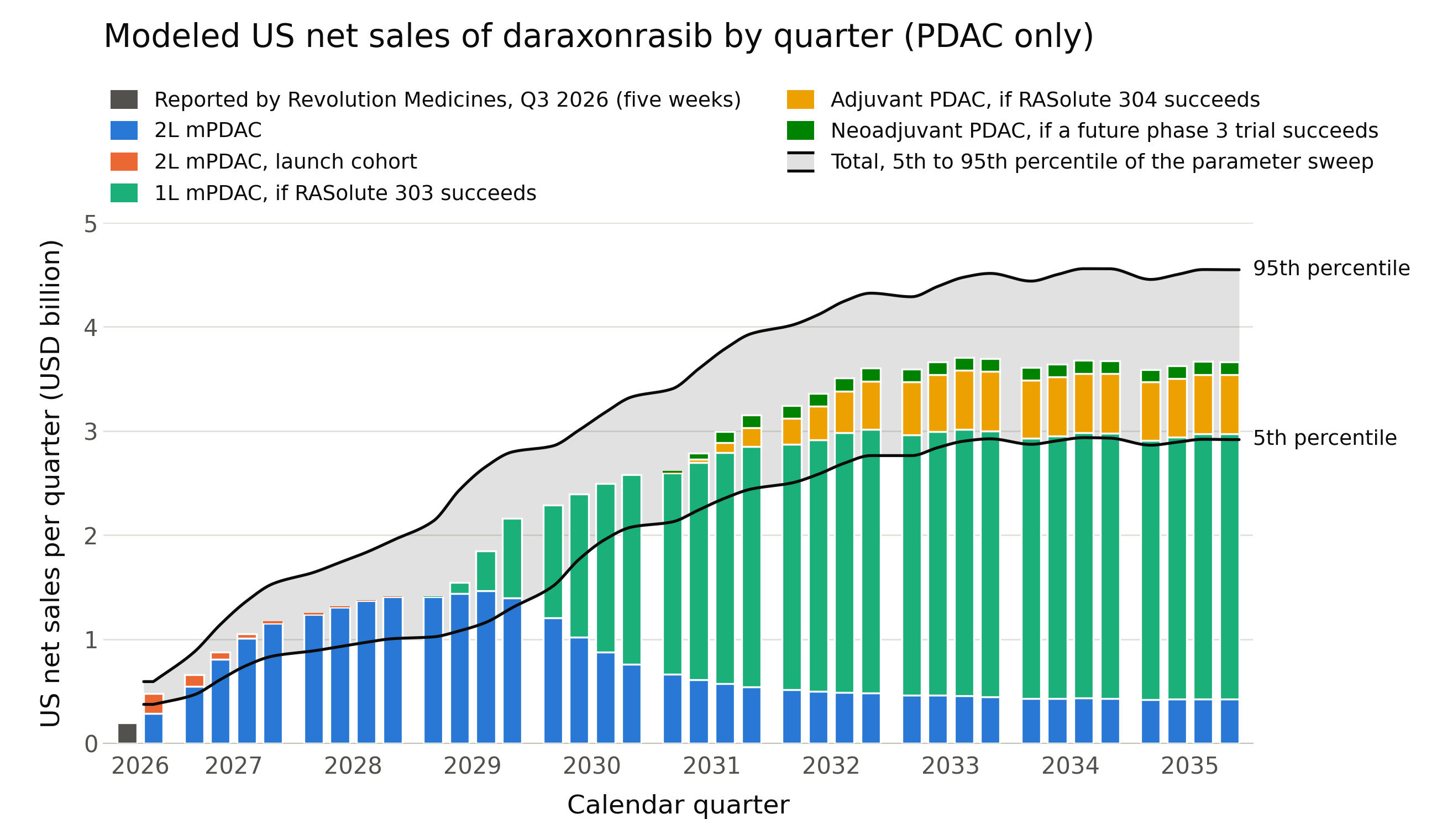
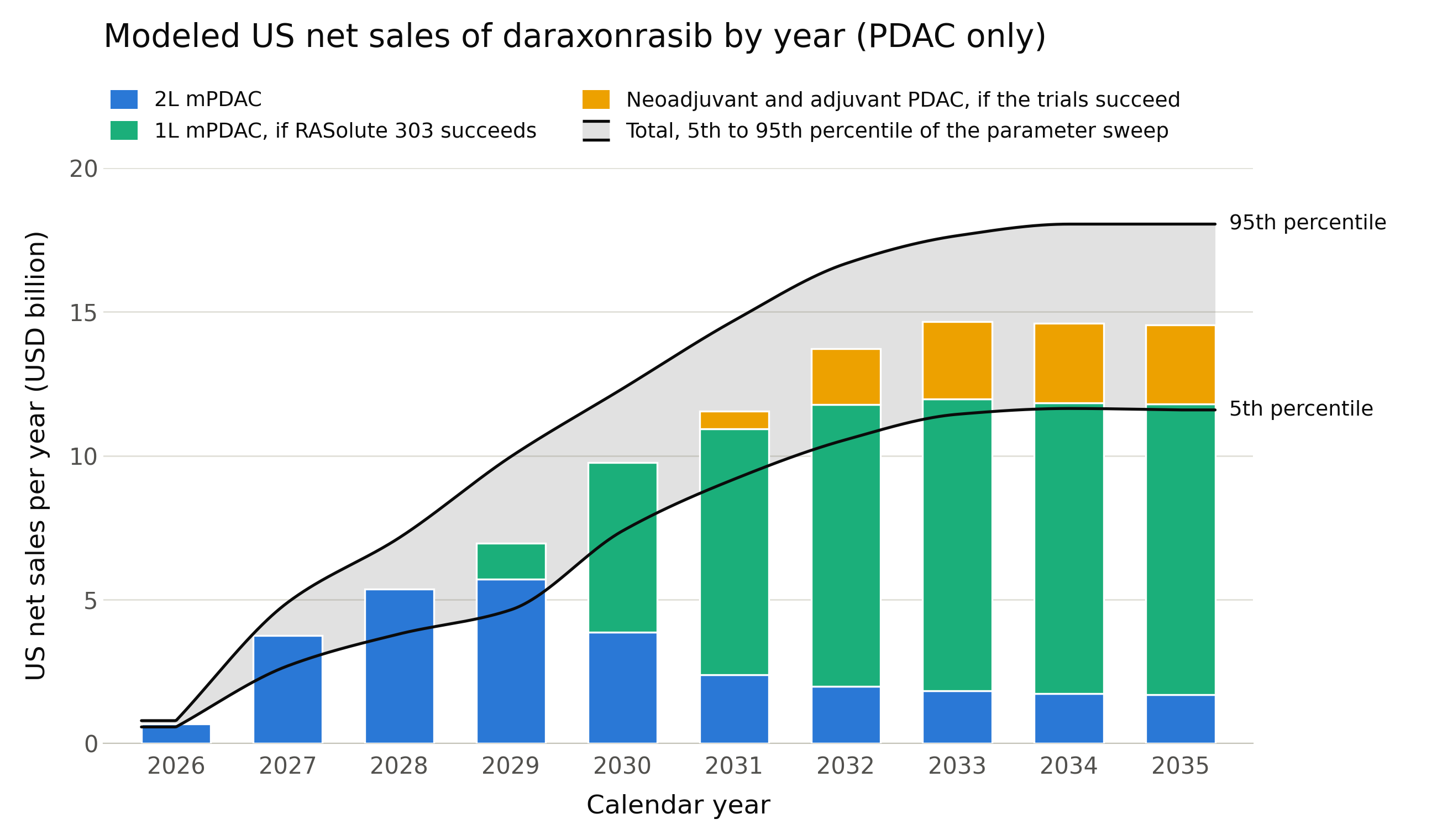
In 2L mPDAC alone, modeled sales level off at $4.1 to $8.2 billion per year. About 8,000 starts per year, about 50% of the patients who reach 2L today, would sustain the launch quarter's annualized pace of $2.0 billion. Most of the range comes from the time on treatment and from the share of 1L patients who go on to daraxonrasib. The blue bars in Fig. 1 and Fig. 2 fall after their peak in 2029 only because both figures assume a 1L label. Patients who start daraxonrasib in 1L do not receive it again in 2L, so most of the 2L sales move to 1L.
If RASolute 303 succeeds, a 1L label would lift modeled sales in mPDAC to $9.7 to $16.3 billion per year at steady state. If it fails, they stay at the level of the approved label. A neoadjuvant label would add $0.3 to $0.7 billion. An adjuvant label would bring $1.7 to $2.9 billion in adjuvant sales, which the central case reaches in 2034. With every label, modeled US net sales in PDAC could reach $14.5 billion in 2035 in the central case, with a range of $11.6 to $18 billion (Fig. 2), most of it from 1L mPDAC.
Nevertheless, success in 2L does not guarantee success in 1L, where chemotherapy is a stronger comparator with a median PFS of 5.6 months and a median OS of 9.2 months on gemcitabine with nab-paclitaxel in NAPOLI-3. Patients in the chemotherapy arm of RASolute 303 can also receive daraxonrasib after progression, which should narrow the difference in OS. A 1L approval may therefore require that the FDA accepts a benefit in PFS, a primary endpoint of the trial next to OS, without a clear benefit in OS.
In the adjuvant setting, meaning after surgery, daraxonrasib would have to eliminate residual microscopic disease, for which we have no evidence, since a benefit in metastatic disease does not imply efficacy in microscopic lesions. There is a biological rationale that these microscopic residual tumor clusters do not respond like bulky metastases do, so nothing is certain here!
The model also assumes that no competing RAS inhibitor reaches the market through 2035, which is highly unrealistic as several competing candidates are in clinical trials. A competing label in any of the four settings would lower the share of daraxonrasib there. The ranges of the sweep do not cover this case.
In October I compared daraxonrasib with Verastem's VS-7375, an oral inhibitor selective for KRAS G12D, the mutation of about four in ten patients in RASolute 302. VS-7375 reached a confirmed response rate of 41% in 22 previously treated patients with mPDAC, while daraxonrasib reached 24% in patients with KRAS G12D in the FDA review. However, this comparison is cross-trial and rests on few patients. Verastem plans to open a phase 3 trial in 1L mPDAC by the end of 2026. If a mutation-selective drug proves more effective in KRAS G12D, daraxonrasib could lose a large part of these patients.
At the same time, competition in PDAC might find it difficult to plan and enroll trials in the US, especially in 1L mPDAC, now that daraxonrasib is approved in 2L. Patients in the chemotherapy control arm of a 1L trial can receive daraxonrasib once they progress. This could dilute a benefit in OS even if the new drug works, so a competitor may need the FDA to accept a benefit in PFS instead. The same will probably soon apply in the EU, where daraxonrasib is approved in 2L as well. The current US label also covers 1L patients who are not candidates for multiagent therapy and probably leaves oncologists some room for judgment. Patients who are offered a trial of an unproven drug candidate against conventional chemotherapy may therefore ask for daraxonrasib instead, which could slow enrollment.
If RASolute 303 succeeds, daraxonrasib could be approved in 1L between July 2028 and November 2029, the window that the model assumes for this label. From then on, a competitor has to decide what the control arm of its own 1L trial should be. If conventional chemotherapy is proven to be inferior to daraxonrasib in 1L mPDAC by then, SOC intravenous chemotherapy would probably no longer be an acceptable control arm. With daraxonrasib as the SOC control arm, the new drug would have to beat or match an effective targeted therapy, which would then be a higher bar than chemotherapy.
However, competitors that are in or near phase 3 today could finish enrolling their trials before daraxonrasib could be approved in 1L mPDAC. Astellas started a phase 3 trial of its KRAS G12D degrader setidegrasib, which is not an oral drug but an intravenous infusion, in February. It compares setidegrasib plus chemotherapy with chemotherapy alone in 614 patients in 1L. The registry estimates its completion for 2029. Verastem's phase 3 trial would open about one and a half to three years before a 1L label of daraxonrasib. Both trials can also enroll outside the US. US enrollment of RASolute 303 is already complete, so this trial no longer competes with them for US patients.
A competitor whose 1L trial is still enrolling when daraxonrasib is approved in this setting would probably be left with later lines, niche indications and combinations. In combinations, daraxonrasib is probably ahead as well, since RASolute 303 tests it with chemotherapy and has an estimated primary completion in April 2028, more than a year before the Astellas trial. Revolution Medicines has also begun to treat patients in RASolute 309, a phase 3 trial of daraxonrasib with zoldonrasib, its own inhibitor selective for KRAS G12D, in 1L G12D mPDAC patients. Its phase 3 trial RASolute 305 gives zoldonrasib with chemotherapy and without daraxonrasib to the same patients, so part of the modeled 1L sales could go to zoldonrasib instead. The trials of Astellas and Verastem need to enroll from the same patient pool.
Patients who started adjuvant daraxonrasib are not counted again when they relapse, because we do not know if they would benefit from the drug a second time. This removes 5% to 9% of the modeled sales in mPDAC at steady state, or $0.6 to $1.3 billion per year. On balance, an adjuvant label adds $0.9 to $1.8 billion per year. Patients who received daraxonrasib only before surgery are still counted again.
If adjuvant or neoadjuvant daraxonrasib reduces recurrence, more patients would probably be cured and fewer would relapse with metastatic disease. The model does not estimate how many. For adjuvant daraxonrasib this makes no difference, because these patients are left out of mPDAC anyway, whether they relapse or not. Patients who would be cured by neoadjuvant daraxonrasib alone are still counted there, so the sales in mPDAC may be slightly overstated then. How large their share would be cannot be estimated, because no trial of daraxonrasib before surgery has reported results yet and a cure only shows after years without a recurrence. This effect is years away, since the model assumes no adjuvant label before August 2029 and no neoadjuvant label before 2030.
Every supply is priced like the approved 300 mg dose, although the combination arm of RASolute 303 gives 200 mg as long as chemotherapy is given. The list price is kept constant, which leaves out price increases. A price negotiated by Medicare can take effect nine years after approval at the earliest, which for Rasonque means January 2036, after the end of the model. Sales outside the US are not included, although the European Commission has now approved Rasonque for previously treated patients.
For comparison, Evercore ISI's estimate after the approval stood at $15.1 billion in 2034 for pancreatic cancer alone, with a peak of $20.8 billion per year once other cancers are included. RBC Capital Markets put the peak at about $11.5 billion per year on the day of approval. A Truist projection from September reached $13.8 billion. BofA's peak figure from April, unadjusted for risk, was $12.3 billion. The reports I found rarely state which indications and regions an estimate covers. My blue-sky scenario of $11.6 to $18 billion in 2035 covers only US patients with PDAC.
The blue-sky scenario painted here assumes that RASolute 303 succeeds and that RASolute 304 succeeds with a median DFS of 23 to 47 months. It assumes that a phase 3 trial of neoadjuvant daraxonrasib, which is not even announced yet (and may never happen), starts soon and succeeds with an early endpoint that regulators accept. It also assumes that every label arrives within its window and that resected patients do not stop early because of side effects. Finally, it assumes that no competing RAS inhibitor reaches the market through 2035.
Follow me on X for frequent updates (@chaotropy).
Legal Information and Disclosures
General Disclaimer & No Financial Advice: The author is not a registered investment advisor or financial analyst, and nothing here is financial, legal, tax, or investment advice, a personal recommendation, an assessment of suitability for any investor, or an offer, solicitation, or recommendation regarding any security. This is not a securities research report and was not prepared under the requirements designed to promote the independence of investment research. It has not been peer-reviewed or audited, represents the author's opinion as of the publication date, and may change without notice. Readers should conduct their own due diligence and consult a certified financial professional before making any investment decision. Readers act on this content at their own risk, and to the fullest extent permitted by applicable law the author accepts no liability for any loss or damage arising from reliance on it.
Medical Disclaimer: The author is a physician, but this article discusses clinical trials and drug mechanisms as general scientific and educational commentary. It is not medical advice, diagnosis, or a treatment recommendation, and it establishes no physician-patient relationship. Readers should never disregard or delay professional medical advice because of anything written here, and should consult a qualified healthcare provider about any medical condition.
Computational Model: Apart from the reported third quarter 2026 revenue, every bar and range in Fig. 1 and Fig. 2 and every sales figure derived from the model is the output of a simulation, not a measurement, not company guidance and not a prediction of what Revolution Medicines will report. The ranges are percentiles of runs with parameters drawn at random from ranges chosen by the author. They are not confidence intervals and cover neither trial failure nor competition. The model rests on the simplifications described in the text, among them an exponential time on treatment and a constant list price. The code has not been independently audited or peer-reviewed, and an error in it could change the results materially.
Accuracy and Third-Party Data: The cited sources are believed reliable but are not guaranteed complete, current, or correct. Many inputs come from the company itself, among them its presentation, its press releases, statements on its earnings call that do not appear in its press release, and a conference abstract with company employees among its authors. Others come from registry entries, which can change, from small or older registry and cohort studies that may not reflect current US practice, and from a review article that reports a conference abstract. The PRODIGE 24 values counted from the end of chemotherapy were read off the published Kaplan-Meier curve and are approximate. The figures on VS-7375 and on daraxonrasib in KRAS G12D are taken from the author's earlier article. Despite the author's efforts to verify the sources cited, this article may contain errors of fact or interpretation.
Disclosure of Interest: The author holds beneficial long positions in Revolution Medicines, Inc. (NASDAQ: RVMD) and Verastem, Inc. (NASDAQ: VSTM). The author holds no long or short position in any other company mentioned. The author reserves the right to buy or sell securities of these companies at any time without further notice. He received no compensation for this article, maintains no business relationship with any company mentioned, and has no access to non-public trial data, unblinded interim results, or internal company information. His positions create a potential for confirmation bias in the design of the model and in the interpretation of its results, and the choice of parameter ranges is where such bias would show first.
Forward-Looking Statements & Risk: Statements here about regulatory outcomes, clinical results, and market potential are predictions subject to significant risks and uncertainties, and actual results may differ materially. The modeled sales beyond the approved label require positive phase 3 trials and approvals that may not occur. Biotechnology and pharmaceutical investing carries a high degree of risk, including total loss of principal, and past performance does not indicate future results.
Copyright: Original text and images are the property of the author and may not be copied, reproduced, or published in whole or in part without prior written consent, except as applicable law or the publishing platform permits. Use of this content to train machine learning or AI models requires explicit authorization. Third-party and public domain images remain subject to their respective rights and are not claimed as the author's property.