
Innovation: America's Perpetual Frontier
At her 250th birthday, America is still opening frontiers. Boosters settle into the arms of launch towers, machines think at scale, and drugs reach targets once thought undruggable. The rational position is an almost delusional optimism about what Americans build next.
Pessimism is often mistaken for critical thinking. For decades, the narrative of the United States in slow decline has echoed in intellectual circles. Paul Kennedy's The Rise and Fall of the Great Powers (1987) mapped imperial overstretch onto Washington, and Robert Gordon's The Rise and Fall of American Growth (2016) called the inventions of 1870 to 1970 an unrepeatable special century.
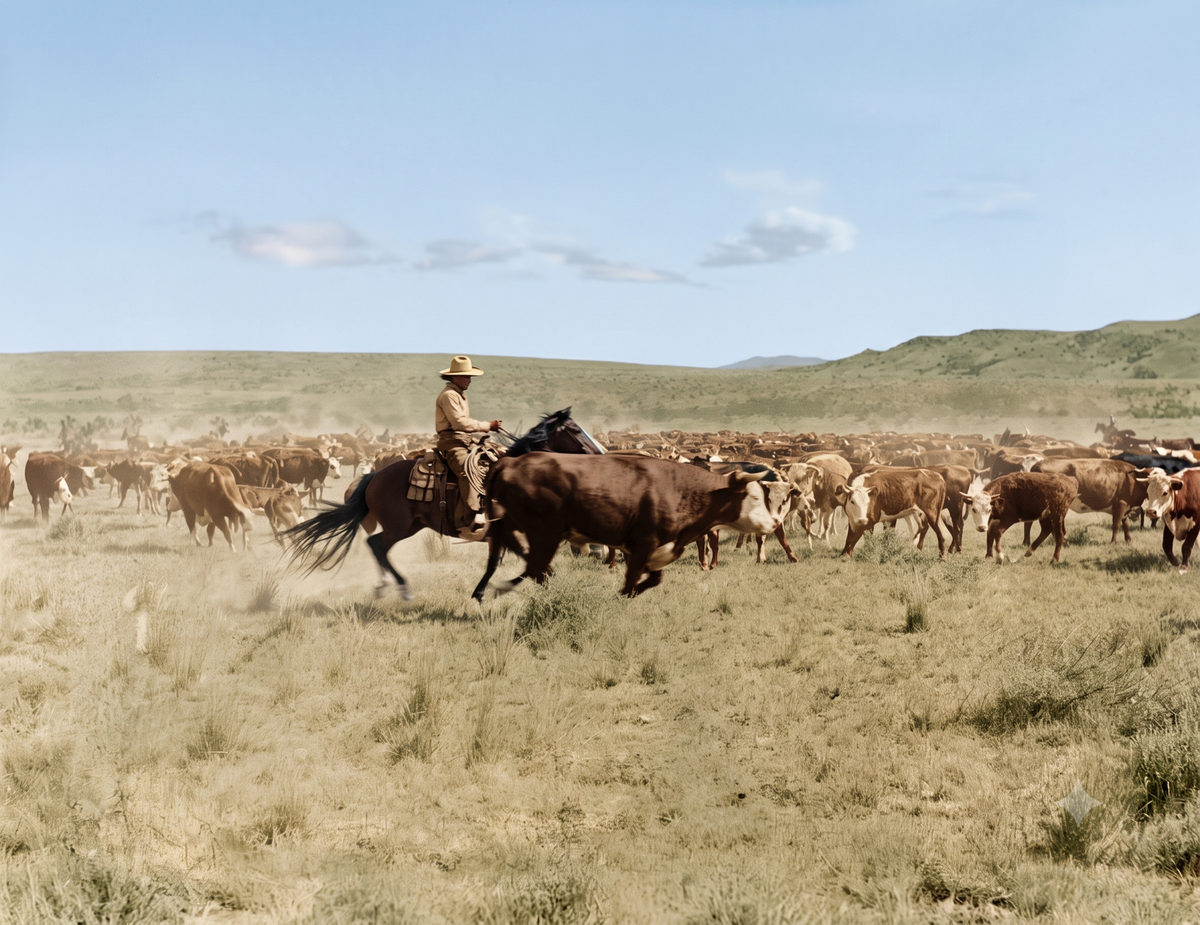
History tells a different story. In 1893, Frederick Jackson Turner told the American Historical Association that the frontier had formed the national character: a perpetual encounter with open land that rewarded improvisation and dissolved inherited hierarchy. The census of 1890 had just declared the frontier line closed, so Turner delivered an obituary. The West was the first frontier. When it closed, Americans opened new ones.
The next frontier was the factory. In 1913, Henry Ford's moving assembly line cut the time to build a Model T from twelve hours to 93 minutes, and the price of the car fell from $850 to as little as $260. What mass production did for the wealth of the masses cannot be overstated: Ford doubled his workers' pay to five dollars a day, and the men who built the cars began to buy them. Mass production made America the industrial center of the world.
After the Second World War, Vannevar Bush persuaded Washington that the next frontier lay in research. His 1945 blueprint Science, the Endless Frontier produced the National Science Foundation and a permanent federal commitment to basic science. That commitment was tested in 1957, when the Soviet Union launched Sputnik and the space race began. The United States founded NASA the next year, Kennedy pledged in 1961 to land a man on the Moon before the decade was out, and on July 20, 1969, Apollo 11 landed two Americans on the Moon, five months before the deadline.
Just a few years later, scientists opened another frontier in biotechnology. Traditional drug discovery meant screening compounds until one worked, as much by luck as by design. Biotech began differently: in 1976, the California company Genentech fused recombinant DNA with venture capital and showed that medicine could be engineered from an understanding of the molecules that cause disease. That approach has since let medicine take on the previously undruggable. Revolution Medicines' daraxonrasib is the most recent breakthrough, a drug against RAS, the protein that drives most pancreatic cancer and had turned away every attempt to drug it for forty years.
For decades after Apollo, rocket launches were government purchases on cost-plus contracts. SpaceX sold them at fixed, published prices, and companies could plan businesses around a known cost of reaching orbit. That transparency, the achievement of Elon Musk's SpaceX, is the foundation of the new space economy. Reusability then attacked the price itself, since every expendable rocket dies delivering its payload. On December 21, 2015, a Falcon 9 first stage landed vertically at Cape Canaveral, the first recovery of an orbital booster, and on October 13, 2024, the first stage of Starship, the most powerful rocket ever built, was caught midair by its launch tower's arms on the first attempt.
Americans then opened the next frontier in intelligence. On November 30, 2022, OpenAI released ChatGPT, and machines had acquired natural language, the medium in which humans negotiate, teach, diagnose, and design. Every earlier technology economized on muscle, distance, or memory. This one economizes on intelligence itself, and a civilization that multiplies its intelligence multiplies its discoveries: new medicines, new materials, a tutor for every child. AI is now entering machines that grip, lift, weld, and drive, and this migration arrives on the factory floor, where the industrial chapter of the frontier began.
Max Weber traced American dynamism in The Protestant Ethic and the Spirit of Capitalism (1904 to 1905) to the Calvinist doctrine of predestination. Denied certainty of salvation, the believer sought evidence in a worldly calling: relentless work, profit reinvested, idleness the gravest sin. That ethic crossed the Atlantic with the Puritans, and the West gave it space: the faith that sanctified work sent families across a continent to raise farms and towns from wilderness, and every frontier since has renewed it. From that fusion of creed and country came the builder as the American type.
The very precondition for this dynamism is the free individuum. The free individual entered history in ancient Greece, where the polis conceived a citizen who reasons in public and decides for himself, and one city produced drama, history, mathematics, and philosophy. Yet citizenship stayed hereditary, confined by Pericles in 451 BC to men with two Athenian parents, the economy ran on slaves, and the city that prized frank speech made Socrates drink hemlock in 399 BC.
In the Old World, freedom never reached the common man, because it was always the privilege of blood. Macedon absorbed the free cities, Rome spread law while draining sovereignty from the citizen, and Europe's later republics were walled oligarchies. For two thousand years the free individual survived as literature, awaiting institutions equal to it.
An ocean from Europe's thrones, colonists, many of them the Puritans whose ethic Weber traced, had governed themselves from the start. When London reasserted control, they made the Greek premise universal: the Declaration of Independence, adopted July 4, 1776, grounded government in the consent of individuals whose rights precede any state. The founding carried terrible contradictions, slavery above all, that its own premise would spend two centuries dismantling.
Eleven years later, the Constitution of 1787 performed a structural inversion. Durable empires organized authority as a pyramid: pharaoh, emperor, crown. Constitutions in that lineage address the people and tell them what to do. This one is written by the people and tells the government what to do. "We the People" is the subject and the government the object: the citizens are the principals, the state their agent.
Article I, Section 8 charges Congress "To promote the Progress of Science and useful Arts," and the unamended Constitution's single use of the word "right" belongs to authors and inventors. The future is unknown, and freedom to try things is decisive: free economies run millions of experiments, let failures die cheaply, and move capital to the survivors, which is how the breakthroughs of this decade emerged.
American innovation has been the largest global equalizing force in history. Iowa agronomist Norman Borlaug bred the wheat that made Mexico, India, and Pakistan self-sufficient in grain, is credited with saving a billion lives, and won the 1970 Nobel Peace Prize. Extreme poverty has fallen by more than 1.5 billion people since 1990, the steepest retreat of deprivation ever recorded, in the very decades American inventions spread worldwide. Apple's iPhone arrived in 2007, a rich country's toy, and by 2023 more than half of humanity owned a smartphone. A smallholder farmer now carries in his pocket capabilities that ministries lacked a generation ago.
At two hundred and fifty, the United States is still opening new frontiers. Boosters settle into the arms of launch towers, machines think at industrial scale, and drugs bind targets once thought undruggable. Each time a frontier closed, Americans opened another.
Pessimism will keep sounding intellectual, because it borrows the grammar of critical thinking while skipping its work. Across two and a half centuries, every generation of doubters has been refuted by a generation of builders. The actually rational position is an almost delusional optimism about what Americans build next.
Follow me on X for frequent updates (@chaotropy).
Disclosure: This essay reflects my personal opinions and is for informational and entertainment purposes only. It is not investment, financial, or medical advice, nor a solicitation to buy or sell any security. I hold no position in Revolution Medicines (Nasdaq: RVMD), SpaceX (Nasdaq: SPCX), or any other company mentioned, and I may buy or sell any security discussed at any time. Do your own due diligence.
Copyright: All original content, including text and images, is the property of the author and may not be copied, reproduced, or published, in whole or in part, without prior written consent, except as permitted by applicable law or the terms of the platform on which it is published. Use of this content for training machine learning or AI models is not permitted without explicit authorization. Third-party or public domain images remain subject to their respective rights and are not claimed as the author’s property.